Custom gas turbine component manufacturing and supply
Gas turbine solutions connect aerodynamic function with material behavior,
component geometry and a controlled manufacturing route. Compressor guide vanes
condition incoming air; turbine nozzles turn the hot flow; blades and wheels
extract shaft work; disks carry rotating loads. ForceBeyond supports custom
component manufacturing and supply across these families, coordinating the
requested casting, forging, machining and inspection scope. The links below help
engineering and purchasing teams move from a component function to a
material-specific enquiry.
Discuss your turbine component program. Send the component drawing,
material and delivery condition, with quantities and the inspection scope. Request a custom quote.
How component function changes the manufacturing problem
NASA’s
turbine overview distinguishes stationary stators from rotating rotors. A stator
controls flow direction without carrying blade centrifugal load; a rotor must transmit
work and survive rotation. Compressor vanes operate upstream of combustion and have a
different thermal and corrosion environment. These differences explain why an airfoil
photograph, alloy name or nominal temperature alone cannot define a production part.
Separate blades have disk attachments that need their own datums and surface controls. An
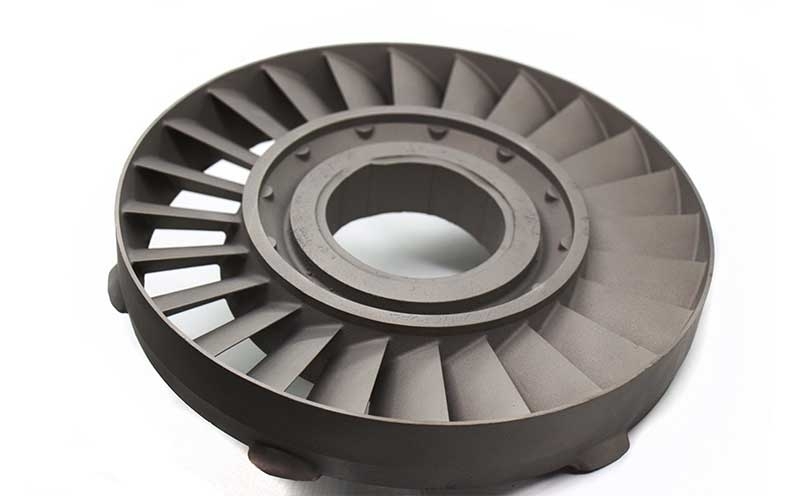
integral wheel combines hub and airfoils, making passage access, local wall thickness and
final rotor verification part of the same manufacturing problem. An assembled nozzle ring
instead depends on segment position, throat area and its locating interfaces.
Explore the five application hubs
Turbine Blades — Rotating airfoils, roots, cooling and casting structures.
Turbine Wheels — Integral rotor geometry, shaft interfaces and balance scope.
Match the material route to the component
Investment casting is useful for complex airfoil shapes and specified internal passages.
Forging establishes a wrought blank for designs that require that structure; CNC
finishing establishes functional datums and interfaces. Single-crystal casting adds
crystal-orientation and defect controls, as discussed in NASA’s inspection research. These
routes create different structures and evidence requirements.
Material families also require distinction. The 718
producer bulletin describes an age-hardenable nickel alloy, while cobalt nozzle
alloys, titanium compressor alloys and stainless guide-vane grades answer different
design needs. Source approval and part-specific properties determine which material is
usable; a capability category is not permission to substitute.
Engineering features to connect with inspection
Component function and manufacturing evidence
Family
Critical relationship
Evidence to plan
Blades
Airfoil to root and tip
Profile, attachment dimensions, cooling and coating checks where
required.
Disks
Bore to rim and attachment
Material route, runout, critical surfaces and specified NDT.
Stator assemblies
Airfoil throat to locating surfaces
Vane position, passage geometry and assembled condition.
Compressor guide vanes
Flow angle to spindle or mount
Profile, clocking, journal fit and motion where variable.
Wheels
Hub and airfoils to shaft axis
Passage geometry, runout and specified rotor verification.
This is a planning comparison; drawings and acceptance standards set actual methods and
limits.
Across the five supply families, a blade is a separate
rotating airfoil commonly planned from an approved casting; a disk carries attached blades from a wrought or
powder-derived blank; a stator vane is
stationary and may be supplied loose or in a segment; a compressor guide vane controls upstream air
with profile and mounting or actuation checks; an integral
wheel combines hub and airfoils in one rotor. Their critical evidence respectively
centers on root/cooling, bore-rim condition, throat/support, flow-angle/axis and
hub-airfoil/runout relationships.
ForceBeyond can review casting or forging blanks, finish-machined parts and defined
segments or assemblies when the required route and source are confirmed. The customer's
design authority owns material selection, life limits and acceptance criteria; a
manufacturing quotation assigns production and record-delivery responsibilities against
that approved definition.
Five gas turbine component supply families
Family and role
Possible starting form, subject to approval
Design characteristic
Inspection category
Rotating blade
Airfoil casting
Root, profile and cooling
Structure, passage and attachment
Separate disk
Wrought or powder-derived blank
Bore, web and rim
Material state, NDT and datums
Stationary vane
Casting or specified segment
Throat and support
Passage and assembly fit
Compressor guide vane
Approved blank or formed part
Flow angle and mount
Profile, spindle or fixed fit
Integral wheel
Near-net casting or approved blank
Hub-to-airfoil load path
Soundness, axis and rotor state
Manufacturing and supply coordination
ForceBeyond can develop a defined supply proposal using its superalloy casting, forging and machining resources. A blank-only
package and a finished component assign different responsibilities for thermal
processing, coatings and release records. Grade-specific capability and processor
approvals are confirmed for the selected program.
The quality and supply-chain plan should
carry material identity through each handoff. First-article dimensions, required NDT,
material test records and customer hold points need a common drawing revision. A coherent
package makes tooling, lead time and recurring production pricing easier to compare.
From feasibility to a production quotation
Identify the component family, actual service location, alloy and required delivery
state, then add drawings, quantities and schedule. A new source may need a feasibility or
first-article stage before recurring production. State balance, flow, proof or special
testing explicitly when the design calls for it; these activities are separate from
dimensional acceptance.
Gas Turbine Solutions — Technical and Supply FAQs
Why are turbine blades and stator vanes separate component families?
Blades rotate and extract shaft work; stator vanes remain stationary and turn the flow for a rotor row. Their load paths, attachments and inspection needs differ even when both are airfoil shaped.
When is an integral wheel different from a disk with separate blades?
An integral wheel includes the airfoils in the rotating part. A disk with separate blades introduces attachment interfaces. The difference changes tooling, machining access, replacement scope and rotor verification.
Does one nickel alloy cover the entire turbine flow path?
No. Alloy and processing choices depend on local temperature, stress cycle, oxidation or corrosion exposure, cooling and approved design data. An alloy family is not a universal service rating.
What can a custom turbine manufacturing quotation include?
A proposal can define a casting or forging blank, precision finishing, or a coordinated finished-component package. The quotation should state included processes, qualification gates, inspection records and customer-supplied items.
Request Custom Gas Turbine Component Manufacturing
Send the component drawing, material and delivery condition, with quantities and the inspection scope.