
ForceBeyond Logo
High-pressure die casting production for aluminum and zinc metal components

Die Casting Services for High-Volume Precision Metal Components

Custom Die Casting for High-Volume Metal Components

ForceBeyond provides custom die casting services for high-volume aluminum, zinc, and magnesium components. High-pressure die casting injects molten nonferrous metal into a hardened steel die to produce repeatable parts with detailed features, thin sections, smooth surfaces, and short cycle times.

Programs may include aluminum die casting, zinc die casting, and magnesium casting. ForceBeyond coordinates tooling, casting, trimming, precision machining, surface finishing, inspection, assembly, and logistics through an integrated manufacturing network.

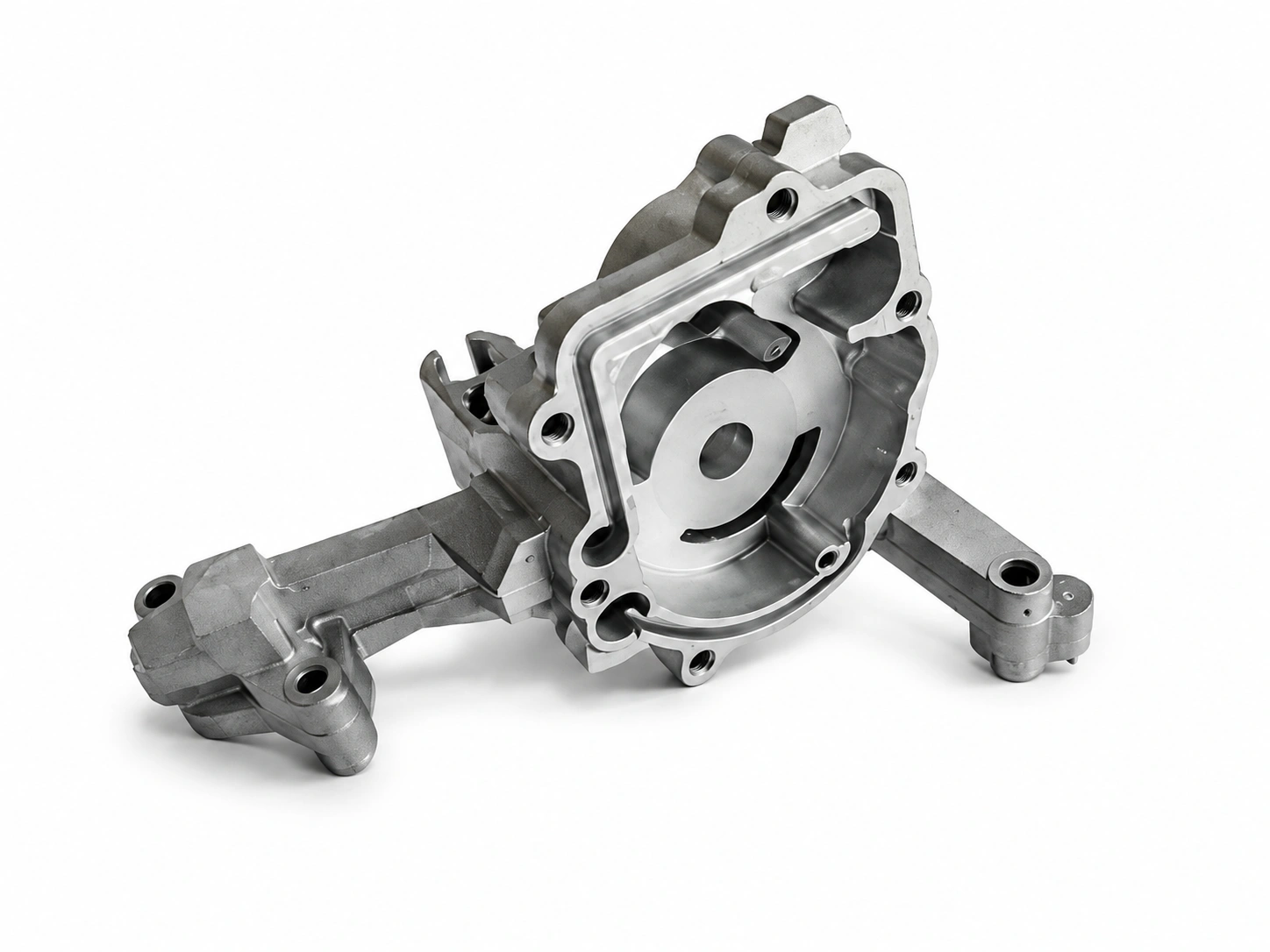
Precision aluminum die-cast automotive housing with machined mounting holes, internal channels, and structural ribs on a white background.

When to Choose Die Casting

Die casting is typically selected when the projected production volume can justify permanent tooling and the design benefits from repeatability, thin walls, integrated features, short cycle times, and reduced secondary processing.

  • Medium- to high-volume production: tooling investment is distributed across larger production quantities.
  • Thin-wall components: high-pressure filling can support thinner sections than many gravity-casting processes.
  • Complex integrated geometry: ribs, bosses, mounting features, heat-sink fins, and lettering can be formed in the die.
  • Repeatable dimensions: permanent steel tooling supports consistent geometry over long production runs.
  • Part consolidation: multiple stampings, fasteners, or machined pieces may sometimes be redesigned as one casting.

Die Casting vs. Sand Casting and Investment Casting

The best casting process depends on annual volume, alloy, size, wall thickness, dimensional requirements, tooling budget, surface finish, and design complexity.

Selection Factor Die Casting Sand Casting Investment Casting
Production Volume Best suited to medium- and high-volume production. Suitable for low to medium volumes and large components. Suitable for low to medium volumes and complex precision parts.
Tooling Cost Higher permanent-tooling investment. Generally lower tooling cost. Moderate to high pattern and tooling cost depending on volume.
Wall Thickness Can support thin sections on suitable alloys and geometries. Usually requires thicker sections. Can support thin and complex sections with broader alloy flexibility.
Alloy Range Primarily aluminum, zinc, magnesium, and selected copper-based alloys. Broad ferrous and nonferrous alloy range. Broad ferrous, nonferrous, titanium, and superalloy range.

Die Casting Alloys and Material Selection

Alloy selection should consider strength, corrosion resistance, thermal conductivity, electrical properties, castability, wall thickness, finishing, pressure tightness, weight, and cost. Published values vary by material condition and test method, so the table below focuses on practical selection rather than fixed guaranteed properties.

Alloy Family Representative Grades Typical Characteristics and Applications
Aluminum Die Casting A380, A360, 383, 413, A413, B390 and application-specific grades Good strength-to-weight ratio, corrosion resistance, thermal performance, and dimensional stability for housings, brackets, heat sinks, gear cases, and automotive components.
Zinc Die Casting ZAMAK 2, ZAMAK 3, ZAMAK 5, ZA-8 and related grades Excellent detail reproduction, thin-wall capability, dimensional stability, plating response, and mechanical performance for hardware, enclosures, fittings, and decorative parts.
Magnesium Die Casting Application-specific magnesium die casting grades Low density and useful stiffness for lightweight housings, frames, brackets, electronics, transportation, and handheld equipment.
Copper-Based Die Casting Application-specific copper and brass alloys Selected where wear, strength, thermal, electrical, or corrosion properties justify higher casting temperatures and tooling demands.

Die Casting Design Guidelines

  • Uniform walls: maintain practical wall consistency to support filling, cooling, dimensional control, and cycle time.
  • Draft: provide sufficient draft for ejection, especially on deeper walls and textured surfaces.
  • Fillets and radii: avoid sharp internal corners that increase stress and restrict metal flow.
  • Ribs and bosses: use balanced proportions to improve stiffness without creating excessive local mass.
  • Parting line and slides: review undercuts, side actions, ejector locations, gates, vents, overflows, and trim access before tooling release.
  • Machining allowance: add stock only where final sealing, bearing, threading, or datum features require machining.

High-Pressure Die Casting Process

  1. Tooling and die preparation: hardened steel dies are manufactured with cavities, cores, slides, cooling channels, gates, vents, and ejector systems.
  2. Metal preparation: alloy chemistry, temperature, cleanliness, and melt handling are controlled before injection.
  3. Injection: molten metal is injected into the die under pressure using a hot-chamber or cold-chamber machine.
  4. Solidification: pressure is maintained while the casting cools and solidifies in the die.
  5. Ejection and trimming: the die opens, ejector pins release the casting, and runners, gates, and flash are removed.
  6. Secondary processing: parts may proceed through deburring, machining, coating, pressure testing, inspection, assembly, and packaging.

Die Casting Tooling and Production Planning

Tool design has a major effect on casting quality, cycle time, maintenance, and production life. Engineering review should address:

  • Gate and runner design: filling sequence, air evacuation, and metal velocity.
  • Thermal balance: cooling channels, local hot spots, die temperature, and cycle stability.
  • Tool steel and coatings: selection based on alloy, shot count, erosion, soldering, and thermal fatigue.
  • Maintenance strategy: inserts, replaceable cores, preventive maintenance, shot tracking, and spare components.
  • Capacity planning: press size, projected annual volume, cavities, automation, trimming, and downstream operations.

Die Casting, Machining and Secondary Operations

Many die-cast components require additional operations before they are ready for assembly.

  • Precision machining: milling, turning, drilling, tapping, reaming, and finishing of bores, sealing surfaces, threads, and mounting datums.
  • Surface finishing and coating: anodizing, conversion coating, plating, E-coating, powder coating, painting, polishing, and cosmetic finishing.
  • Inspection and testing: dimensional inspection, CMM reporting, leak testing, pressure testing, porosity evaluation, and coating verification as required.
  • Assembly and kitting: inserts, bearings, seals, hardware, sub-assembly, labeling, and protective packaging.

Die Casting Applications by Industry

Frequently Asked Questions: Die Casting

What is the difference between hot-chamber and cold-chamber die casting?

Hot-chamber die casting keeps the injection system in contact with molten metal and is commonly used for lower-melting-point alloys such as zinc. Cold-chamber die casting transfers molten metal from a separate furnace into the shot chamber and is commonly used for aluminum and other alloys that would attack or overheat a hot-chamber injection system. Final process selection depends on alloy, part size, tooling, cycle time, and production requirements.

Why choose die casting instead of sand casting?

Die casting generally provides faster production cycles, thinner walls, smoother as-cast surfaces, and tighter repeatability than sand casting. Sand casting is often more suitable for larger parts, lower production volumes, or projects that cannot justify permanent tooling. The most economical choice depends on annual volume, geometry, alloy, tooling budget, tolerance, and finishing requirements.

Which die casting alloys are suitable for decorative finishes?

Zinc alloys such as ZAMAK 3, ZAMAK 5, and ZA-8 are frequently selected for plated or decorative parts because they cast fine details and accept many finishing systems well. Aluminum can also be anodized, painted, powder coated, plated with suitable pretreatment, or conversion coated. Finish selection should consider alloy chemistry, cosmetic class, corrosion exposure, masking, and dimensional impact.

What information is needed for a die casting quote?

Provide a 2D drawing and, when available, a 3D CAD model, along with alloy preference, annual and batch quantity, critical tolerances, wall thickness, cosmetic requirements, machining, coating, pressure-tightness, inspection, assembly, packaging, and delivery expectations. Clearly identify critical-to-quality features and expected production life.

Request a Die Casting Quote

Send your drawing, CAD model, alloy, annual volume, wall thickness, tolerance, cosmetic, machining, coating, testing, and delivery requirements for an engineering review.

Technical References
Related Die Casting, Machining, Finishing and Quality Resources